99 Nights Low-Visibility Play: Keep Orientation Without Trusting an Unchecked Shape
Darkness and a limited view can make familiar routes and distant shapes harder to interpret. Prepare supported display and camera controls, use confirmed landmarks and keep uncertainty visible rather than acting as if every shadow has been identified.
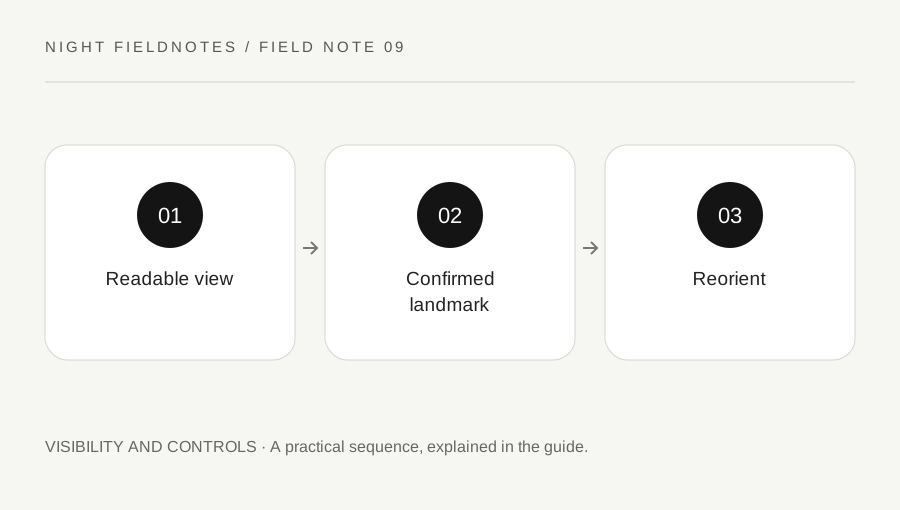
Original explanatory diagram. Examples illustrate a method or decision; they are not claims of personal testing.
Prepare the supported view before a difficult moment
Inspect the current camera, volume and accessibility options through Roblox's in-experience settings and the controls available in 99 Nights. Choose a setup that lets you read prompts and maintain orientation comfortably. The experience can limit some camera options, so use what is actually offered.
Do not install a modified client, visibility script or overlay that reveals information the game does not normally provide. Apart from rules and account risks, an unsupported tool makes any ordinary-play guide built around it misleading.
For example, if interface backgrounds are difficult to read, examine supported contrast-related options rather than assuming that an unrelated graphics change solves the problem. If movement makes the camera difficult to manage, isolate that control in a manageable area first. The purpose is a readable supported setup, not a claim that one display value removes every challenge or changes how a creature behaves.
Use confirmed references in the route
Before moving through a low-visibility area, identify the last landmark you can confirm and the next reference you expect. Keep the connection short enough to remember while watching the current conditions. A vague dark shape should not become a confident destination merely because you hoped it was familiar.
When traveling with a teammate, describe the landmark rather than only your own screen direction. "Beside the recognizable structure" can be more useful than "over here" when the other player approaches from a different angle.
Suppose a route looks familiar until the next expected landmark fails to appear. Recheck from the last confirmed reference if practical. Continuing farther in the same uncertain direction adds distance without adding evidence. This is an orientation method, not a fixed route for every generated situation. Current terrain, placed objects and updates can change what is recognizable, so verify the references instead of memorizing an unexplained sequence of turns.
Describe unknown threats as unknown
A sound or shape can justify attention without establishing exactly what produced it. Combine the observation with the current view and the game's visible feedback. Avoid giving teammates a precise creature identity or location when you have only a brief uncertain impression.
A call such as "movement near the return route; not identified" tells the group what needs checking. It is more useful than a confident wrong label that sends players toward an unnecessary fight or away from the actual threat.
If an equipped light or other supported tool is available, use its current instructions and observed behavior. This guide does not claim a universal stun duration, immunity or counter for every creature. Reassess after an encounter rather than assuming one successful reaction proves a permanent rule. Keep the return route in mind while looking; attention fixed on a single uncertain shape can make you lose the landmarks that mattered before the sighting.
Recover orientation before extending the task
When confused, separate finding your position from completing the original objective. Identify the nearest confirmed reference, check your actual character state and choose a manageable next movement. Do not add an optional collection or fight while the basic route remains uncertain.
If with others, say what you can see and what you have lost track of. A useful response may be a stationary meeting point, not chasing a teammate who is also moving through an unclear area. Avoid filling chat with contradictory directions while everyone searches independently.
After returning, update one part of the route note or control habit. Perhaps the landmark was too generic, the camera turn hid the path or the group failed to agree on a meeting point. Low-visibility play improves when supported controls and honest observation work together. It does not require pretending to identify every shadow or relying on an unofficial brightness trick as though it guarantees safety in all current and future versions of the forest.
A practical checklist
Choices are saved in this browser. Reset them here or clear this site’s browser storage.
Questions that come up
Does a sound identify a creature with certainty?
Not by itself. Combine it with current visible evidence and describe uncertainty when the source is unconfirmed.
Does this page prescribe creature stun timings?
No. Use the current tool instructions and game behavior; no universal counter or duration is claimed.
What is a useful lost-player call?
Give the last confirmed landmark and what you can see now, then agree on a stationary reference or next step.
References & scope
Background references checked on 18 October 2026. Worked examples and diagrams are original teaching material.